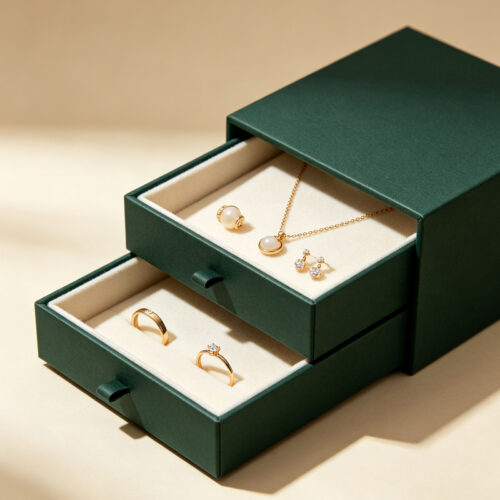
What is slotted insert fabrication? It involves cutting slots shaped like the product into the insert material; the product is then embedded into these slots for secure positioning and cushioning. The quality of the slotting determines two things: how securely the product is held and the perceived quality (premium feel) upon opening the box.
What products is it suitable for? Electronics, glass bottles, cosmetics, and jewelry—essentially any product that is sensitive to shaking, impact, or breakage. For high-end gift boxes, a flocked slotted insert creates a sense of refinement the moment the box is opened—a detail that cannot be replicated by other features.
Securing methods vary in approach. “Locking” involves the product snapping into the slot; “wrapping” means the slot walls encase the product’s sides; and “supporting” means the slot base bears the product’s weight. When combined, these methods ensure the product stays fixed within the box—preventing movement during transport and keeping everything in place upon opening.
The true skill of insert fabrication lies in the details of the slots. With the same piece of EVA foam, varying the slot depth yields completely different securing results; this is the technical nuance of the process. This article explains slotted inserts clearly, offering practical insights for clients involved in precision product packaging.
Different materials require different processes. EVA foam is processed via milling or die-cutting, resulting in clean edges and good elasticity; paper pulp trays are formed by stamping and are eco-friendly/recyclable; flocked inserts are formed first and then flocked, ensuring the velvet-like finish covers the slot walls. Material dictates the process, and the process dictates the outcome; therefore, select the material before discussing slotting specifications.
A few key considerations: Prototyping must use actual products—real devices, bottles, or jewelry—to test the fit, as the physical item determines the ideal tightness. During mass production, tolerances must be controlled, and slot dimensions should be spot-checked regularly. For flocked inserts, pay attention to the uniformity of the flocking. The insert represents a “hidden” cost, yet it delivers a tangible, premium tactile experience.
Slot depth and tolerance are critical. Slot depth is calculated based on the product’s actual dimensions, and tolerances must be controlled at the millimeter level: if the slot is too shallow, the product protrudes; if it is too deep, the product becomes embedded and difficult to remove. For precision products (electronics, glass bottles, cosmetics), even a slight dimensional discrepancy significantly alters the user experience.