Post-processing steps: die-cutting, box gluing, lamination/mounting, and handle attachment.
Key factors to consider when choosing an export packaging supplier:
Equipment and production capacity. Checking the actual equipment on the factory floor and confirming whether they can accommodate orders during peak seasons is far more reliable than looking at promotional images on a website.
In my years of working in export packaging, I’ve encountered similar inquiries almost daily. Many buyers new to custom packaging and printing tend to focus on unit price first; however, the problems that eventually arise usually stem not from the price, but from craftsmanship, lead times, and regulatory compliance. This article breaks down these issues to serve as a reference for those preparing to place an order.
For small-batch custom packaging with limited budgets and low minimum order quantities (MOQs), prioritize manufacturers that offer digital printing; this lowers the entry threshold and allows for flexible design adjustments. Regarding lead times, calculate the total duration—including prototyping, approval, mass production, and international logistics—and work backward from your deadline; it is crucial to build in a buffer, especially for orders placed during peak seasons.
What exactly goes into “customizing” packaging and printing?
Export experience. Manufacturers with experience in export packaging are more familiar with details like shipping marks, carton compression strength, and customs documentation, helping you avoid potential pitfalls early on.
Packaging materials: white cardstock, coated paper, corrugated cardboard, and specialty paper.
The most common types of packaging for export orders include color boxes, corrugated cartons, premium gift boxes, and self-adhesive labels. The priorities differ significantly depending on the category:
Food packaging manufacturers: Materials must meet food-contact safety standards, and eco-friendly inks are recommended.
Prototyping and communication efficiency. With time zone differences involved in export orders, a manufacturer that responds quickly and produces accurate prototypes can save you a great deal of stress throughout the project.
For the same color box, the visual results, costs, and production timelines differ vastly between offset printing and digital printing; for a carton, there is a significant difference in load-bearing capacity between three-layer corrugated board and five-layer reinforced board. In the quote provided by a custom packaging manufacturer, every item corresponds to a different set of choices:
Last month, a client exporting home storage products approached me asking, “Can your factory handle small-batch custom packaging orders?” He had previously contacted several other packaging manufacturers, only to find either exorbitantly high MOQs or shockingly expensive prototyping fees. He finally admitted the truth: finding a packaging manufacturer is even more exhausting than finding clients.
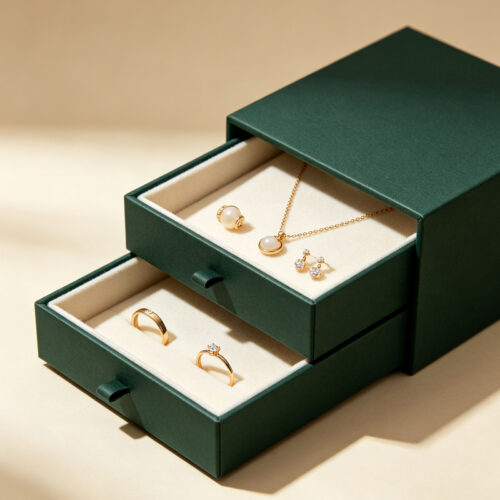
Custom premium gift boxes: Greyboard with paper lamination and foam inserts; suitable for exporting gifts and high-end consumer goods.
Custom corrugated boxes: For long-distance ocean shipping, the focus is on compressive strength and moisture resistance.
Eco-friendly packaging materials are an unavoidable topic in foreign trade.
Common export packaging categories and their corresponding manufacturing processes.
Qualifications and test reports: For food or cosmetic packaging orders, clients usually require proof of food-grade materials or relevant test reports. Asking for qualifications upfront is far more practical than simply listening to a supplier talk about their years of experience.
Surface treatments: Lamination, hot stamping, embossing/debossing, matte coating.
Comparing prices is meaningless until these specifications are clearly confirmed.
Ultimately, when it comes to custom packaging and printing, choosing the right manufacturer ensures a smooth process, whereas the wrong choice leads to endless headaches. If you have an order or a sample on hand, simply send us the files; we can provide a quote based on the actual materials and processes, which is much more efficient than inquiring with various suppliers online.
Custom cosmetic boxes: Typically use white cardstock combined with UV coating and hot stamping; the unboxing experience and tactile quality are key.
In recent years, the EU and North America have tightened packaging regulations; eco-friendly materials have shifted from being a “bonus” to a mandatory requirement. FSC-certified paper, water-based inks, and biodegradable materials are frequently mentioned in procurement inquiries. For orders destined for the European market, it is also crucial to pay attention to local regulations regarding packaging recyclability—clarifying this early on saves a lot of trouble.
Discussing small-batch packaging customization and lead times.
Printing processes: Offset printing, flexography, digital printing, spot UV coating.