The Exchange Card: Putting Your Returns and Size-Swap Process in the Box
Most exchange requests stall not because customers are difficult but because nobody told them the steps — so they email, wait, and quietly buy the replacement elsewhere. A single insert card that spells out the swap process at the unboxing moment fixes most of that, and it doubles as a keepable reference the customer pins to the fridge. Here is what it must say, how to design it, and when it is not worth printing.
اطلب عرض أسعار
أدخل الكمية التي تحتاجها وأضفها إلى قائمة عروض الأسعار الخاصة بك للاستفسار عن الأسعار.
الوصف
Look at where apparel and gift brands lose exchange customers and the pattern is consistent: the customer decides to swap a size, discovers they do not know how, opens a support ticket, waits a day for the reply, and meanwhile the replacement is one search away from a competitor. The information gap is not a support problem — it is a packaging problem. An insert card that states the exchange process in four lines, placed where the customer finds it while opening the box, converts a moment of doubt into a step-by-step path back to your checkout. It costs cents per order and prints on the same run as your thank you card. This article covers what the card has to state, the two-panel design that makes it work, and the categories where it is genuinely unnecessary.
What the Card Must Say: Five Facts, One Screen of Reading
An exchange card earns its keep by answering every question a hesitant customer would otherwise email. Five facts cover it: what qualifies (size and colour swaps within a stated window — 14 and 30 days are the common choices), how to start the swap (a short URL or QR to the request portal), who pays return shipping (you, the customer, or split — ambiguity here is the biggest ticket-generator), how long the replacement takes to arrive (a stated range, for example 5–10 working days after the return scans), and what condition the item must be in (unworn, tags attached). Answer these on the card and the support inbox handles exceptions instead of routine: the volume of “how do I swap” tickets typically drops sharply, and each remaining ticket starts from an informed customer rather than a blank one. The card also sets expectations before the first email is written, which changes the tone of every conversation that follows — customers who know the timeline rarely chase it.
- Swap window and what qualifies — stated in days, not “contact us”
- One action to start — a QR or short link, never a phone-tree instruction
- Shipping responsibility — printed plainly, because silence reads as “you pay”
- Replacement timeline — a range the fulfilment team can actually keep
- Condition requirements — unworn, tags on, packaging kept
The Two-Panel Design: One Half to Keep, One Half to Send Back

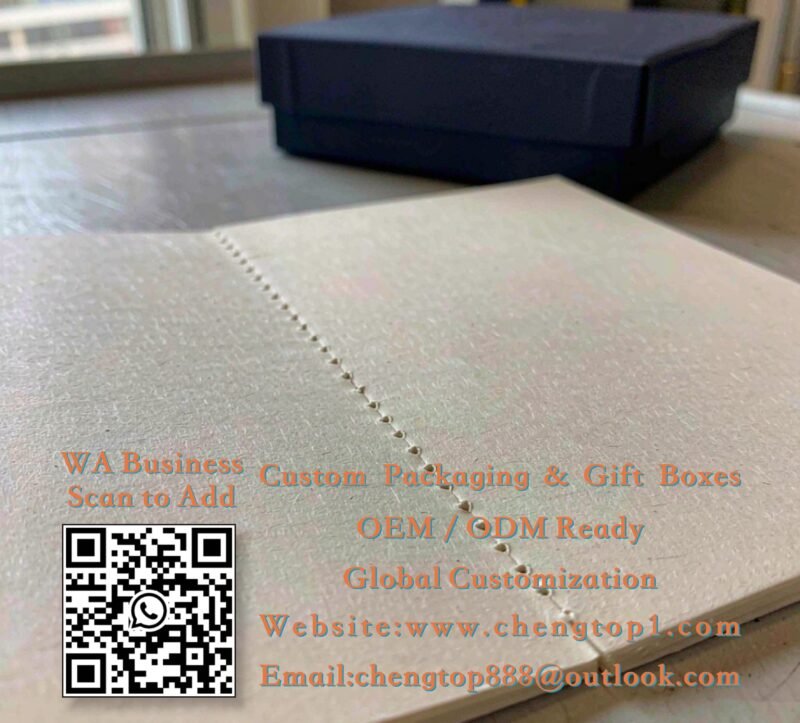
The design decision that separates a useful exchange card from a forgotten flyer is the split. A two-panel card, divided by a perforation line down the middle, assigns each half a job: the keep panel carries the thank-you message, the size chart and a reorder incentive; the return panel is the swap ticket — order reference, reason checkboxes, a space for the requested size, and instructions to enclose it in the return parcel. The perforation does the persuasion: tearing off the return half is a physical commitment, and a customer who has completed a form is measurably more likely to finish the exchange than one facing a blank email. Print on 250–300 gsm uncoated stock so both halves survive the return journey and take handwriting without smearing, and keep the swap-start QR on both halves in case the keep panel gets separated from the return. If the return parcel needs sealing, the same run can include a seal sticker so the repacked box closes cleanly on its way back.
When a Printed Exchange Card Is Not Worth It
Honest exceptions exist. Digital-first brands whose entire post-purchase journey runs through an account portal do not need paper intermediaries — a card that says “manage everything in the app” is a thin value proposition. Categories with negligible swap rates, such as consumables and food, gain little from exchange logistics on paper. And brands that process returns through a label-in-box programme already have their own insert doing this job. For everyone else, the card is worth printing precisely because the alternative — customers improvising the process — is where exchanges quietly turn into refunds, and refunds into lost orders. Track one number after launch: the share of exchanges started through the card’s link versus through support. When the card’s share climbs, the process has moved out of the inbox and back into the funnel where it belongs.
FAQ: Sourcing Exchange Cards for Apparel and Gift Orders
What is the MOQ for custom exchange and insert cards?
Most custom card orders start at 500 to 1,000 pieces for a first run, with a lower unit cost at larger quantities; the minimum shifts with card size, stock, finishing and any die-cut or perforation. custom thank you cards For a first launch we can quote a tiered MOQ that covers your opening run without leaving you with spare stock.
How long do sampling and bulk card orders take?
A digital or printed proof usually takes 3 to 5 working days after artwork confirmation, and bulk card production runs 7 to 12 working days once the sample is approved. Perforation, foil stamping or special stocks add a little time, so send both the card and any matching packaging target dates. نشرات التعبئة والتغليف
What paper stock and finish suit a two-panel exchange card?
For exchange and size-swap cards, a 250–300 gsm uncoated or matte stock prints cleanly and survives folding and fulfilment handling; we match the weight and finish to how the card is handled and where it sits in the box. custom thank you cards
Can you print our swap policy, QR code and size chart on one card?
Send your logo vector file, Pantone or CMYK references and the card dimensions. We check contrast, minimum text size and any QR or barcode legibility before press, and adjust the layout where one language or panel is too tight. stickers and labels
Can the cards match our boxes, bags and seal stickers as one set?
The cards print to match your other packaging so the whole unboxing reads as one brand; ordering the set together keeps paper colour and finish consistent and usually improves the price per piece. custom paper bags and علب هدايا صلبة
Ready to Put the Process in the Box?
Send us your exchange window, portal link and logo — we will suggest a two-panel layout, run a free artwork check and reply with a quote within 24 hours.