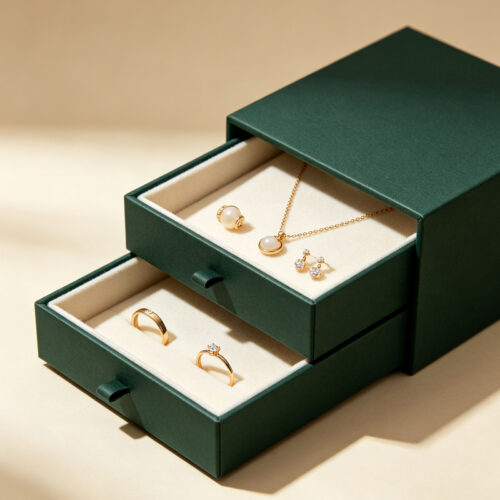
There are plenty of options when it comes to box structures. Flip-top boxes are the standard choice, while two-piece (lid-and-base) boxes offer greater stability. Window boxes—commonly used for food and toys—showcase the product directly. Auto-lock bottom and tuck-bottom structures are ideal for scenarios requiring frequent opening and closing. Simpler structures mean lower unit costs; it is best to clarify your product display needs before deciding whether to opt for a non-standard shape.
First-time packaging buyers often confuse standard color boxes with gift boxes; in reality, they operate on completely different logics regarding structure and cost. Color boxes are formed by folding a single sheet of paperboard; they are cost-effective and suitable for mass production, making them the mainstream choice for high-volume categories like daily necessities, food, and digital accessories. Understanding the materials and manufacturing processes involved is the first step toward managing your packaging budget.
Regarding printing and finishing, offset printing is the standard for color boxes, ensuring color consistency across large batches, while digital printing offers greater flexibility for small-batch or multi-variant orders. Lamination is a common surface treatment—gloss lamination creates a vibrant look, while matte lamination offers a refined, understated finish—and both protect the printed surface. Techniques such as spot UV, hot stamping, and embossing can also be applied, allowing for high-end customization.
Color boxes offer fast prototyping and low costs, making them the most economical choice for packaging testing. Once the sample is approved, the unit cost advantage in mass production is significant, making custom folding color boxes ideal for high-volume products. If your product is still in the market validation phase, starting with a small trial order allows you to test the waters before scaling up—minimizing risk while gathering quick feedback.
Color boxes are perfect for products where you want to spend your budget wisely; their strength lies in achieving impressive results at a modest cost. If you are looking for a packaging solution, simply send us details regarding the product type, dimensions, quantity, and market positioning. We can evaluate color box options for you and provide a comprehensive breakdown covering materials, manufacturing processes, and pricing.
Color boxes have distinct characteristics. They are formed from a single sheet of paperboard through die-cutting, creasing, and folding. Their simple structure saves space during flat-packed shipping and reduces warehousing costs. Thanks to mass production, unit costs can be kept very low. Don’t assume color boxes are limited to budget-friendly products; with the right materials and finishes, they can achieve a premium feel comparable to gift boxes—it all comes down to your choices.
The choice of material determines the box’s rigidity and tactile quality. White cardstock offers excellent print fidelity, making it the top choice for most color boxes; meanwhile, grey-back white board offers superior rigidity and cost-effectiveness, making it suitable for products where structural strength is a priority. For applications requiring high load-bearing capacity, a layer of corrugated board can be laminated onto the cardstock. Paper weight is another variable; for the same box design, using 250gsm versus 350gsm paper results in differences in both tactile feel and cost.