Custom Paper Bags: How Folding, Bundling and Carton Specs Cut Your Storage Costs
Ten thousand flat-folded bags can sit on one pallet position or spread across three, and they can arrive crisp or limp depending on how they were folded, bundled and boxed. Those decisions are made on the purchase order, not in the warehouse. Here is what to specify so your custom paper bags store cheaply and open cleanly.
Demander un devis
Indiquez la quantité souhaitée et ajoutez-la à votre liste de devis pour obtenir un devis.
Description
Most storage problems with paper bags are not warehouse problems. They are order problems. The folding method, the bundle size, the carton spec and the storage conditions are all settled at quotation — or quietly defaulted by the factory and discovered later when the bags will not fit the shelf or come out of the box soft. This guide covers the two folding options, the bundle and carton numbers that turn a quantity into a storage plan, and the humidity rules that decide whether the bags still look good a year from now. Our custom paper bags ship flat by default, which is where most of the saving sits.
Flat-Folded or Half-Folded — and Why It Changes Your Shelf Count

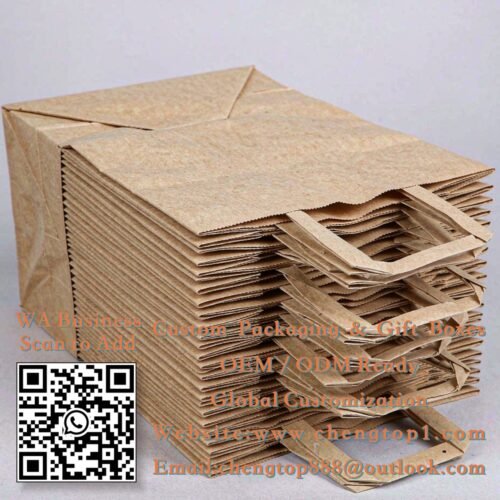
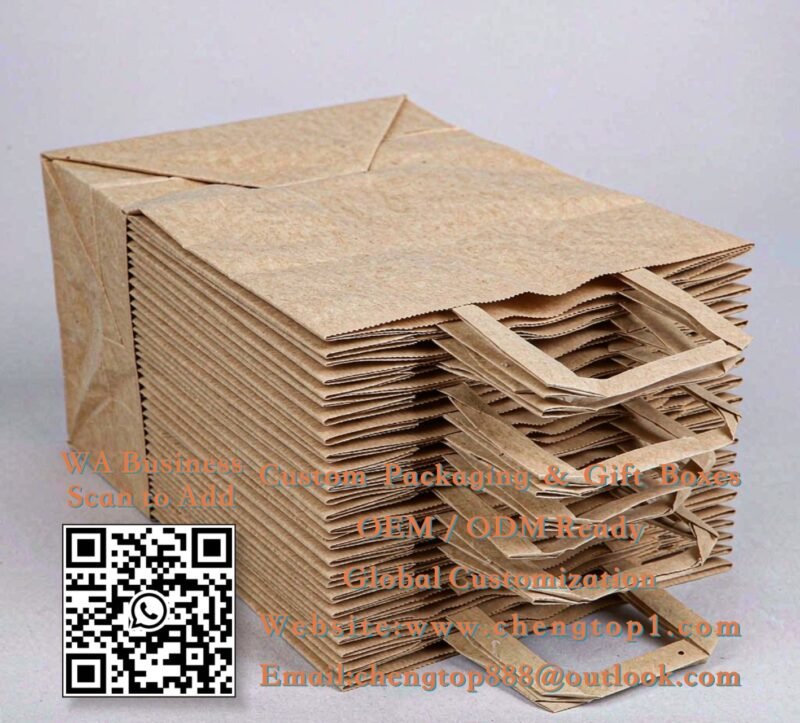
All shopping bags ship flat, but “flat” hides two options. A standard flat fold keeps the bag at full height with the side gussets tucked in and the handles pressed down, so a single 250 gsm medium bag occupies roughly 8–10 mm of stack depth. A half-fold bends the bag once at the middle and halves its length — common for large 400 × 500 mm bags because it cuts the stack height in half, at the cost of a visible crease that softens out after a few uses. Ask which one the factory defaults to, because it changes the carton dimensions and the shelf count before anything is printed.
Check fold quality at incoming inspection, not just the print. Gussets folded crooked make the bag hard to open at the till; handles pressed at an angle crack the coating on laminated bags. On a squared-bottom bag, open five at random and check the base folds snap flat without splitting — a weak base fold shows up after the bag is loaded, not before. Put fold-and-open checks into the same AQL 2.5 inspection as print appearance; they cost nothing extra and catch the failures that ruin a retail morning.
- Standard flat fold at full height, or half-fold for large bags to halve the stack length
- Open five bags at random and check gusset alignment, handle creases and base folds
- Include fold-and-open checks in the AQL 2.5 inspection, not just print appearance
Bundles, Cartons and the Stacking Math

Bags travel in bundles of 50 or 100, crossed with a plain paper band rather than plastic strapping, which cuts into the coating on a laminated bag. Cartons should stay under about 18 kg so one person can lift them, and the carton size should match the folded bag footprint with 10–20 mm of clearance — a loose carton lets bundles shift and crush corners, a tight one splits at the seams. Ask for the carton dimensions and pieces per carton in writing, because that is what turns “10,000 bags” into a storage plan: at 100 per bundle and 10 bundles per carton, 10,000 bags is ten cartons and roughly one pallet position.
Five carton layers is the usual safe stacking limit on standard export cartons; beyond that the bottom layer starts to crush. If the bags go into racking, check the shelf depth against the carton depth before the order is placed rather than after the truck arrives. Put the batch number on the carton and the packing list so an inbound count check takes minutes. Mixing two bag sizes in one carton to save space is a false economy — the smaller bundles shift inside and the counts stop matching the packing list, which is exactly the argument nobody wants to have during a stocktake.
- Bundles of 50–100 crossed with paper bands; cartons under about 18 kg for one-person lifting
- Get carton dimensions and pieces per carton in writing before planning rack space
- Five stacking layers maximum; never mix two bag sizes in one carton
Humidity Is the Real Enemy in Storage
Paper bags are humidity-sensitive goods in disguise. Store them at 20–25°C and 50–60% relative humidity, off the floor on pallets and about 10 cm off the wall. A concrete floor in a humid month wicks moisture into the bottom carton, and those bags come out limp with soft handles. Kraft shows it fastest, white board yellows, and laminated bags curl at the edges. A sensible planning figure is 12 months from production in good conditions, so order for turnover rather than hoarding, and rotate stock first in, first out — the carton batch numbers from the section above are what make that rotation possible.
At the shop end the same rules shrink but do not disappear. Keep the opened bundle away from the door draught and the till’s heat output, and take bags from the front of the bundle so the back stays pressed and flat. If the bag is part of a set — a thank you card tucked inside or a custom sticker sealing the top — store the components together in sealed boxes and match their batch codes, otherwise a reprint of one piece slowly diverges in shade from the rest. None of this needs a climate-controlled room. It needs a dry corner, a pallet and a rotation habit.
- Store at 20–25°C and 50–60% relative humidity, on pallets and off the wall
- Plan around 12 months of shelf life; rotate first in, first out
- Keep cards and seals stored with their bag batch so shades stay matched
Ready to Order Bags You Can Actually Store?
Tell us your bag size, folding preference, target quantity and how the bags will be stored — we will reply with a folding and carton suggestion, a free artwork check and a quote within 24 hours. Samples take 3–7 days, production 10–15 working days after approval, express 5–7 days and sea freight 20–40 days.