

Beyond the Seal: Fitting Holographic Stickers Into a Full Brand Protection Plan
A holographic seal works — but only as one layer of a protection plan that also covers trademarks, packaging consistency and marketplace enforcement. Brands that buy the seal and skip the other layers still get copied. This article maps the full stack, the order to build it in, and what each layer contributes when a fake appears.
Demander un devis
Indiquez la quantité souhaitée et ajoutez-la à votre liste de devis pour obtenir un devis.
Description
The most common brand protection mistake is treating one tool as the plan. A holographic security sticker stops casual copying, but a determined counterfeiter works around any single layer — they copy the box design while skipping the seal, then let the market do the convincing. What actually protects a brand is a stack: registered trademarks that give you legal leverage, packaging consistency that makes fakes visually detectable, an authentication seal that lets buyers verify in seconds, and monitoring that finds infringements early. None of these layers is expensive on its own; the cost is in deciding the order and keeping them consistent. Here is how the layers fit together and what each one contributes on the day a fake shows up.
The Protection Stack: Four Layers, Each With a Different Job

Think of brand protection as four layers doing four different jobs. The legal layer is your trademark registration in the markets where you actually sell — it is what turns an infringement from an annoyance into a takedown filing. The physical layer is packaging produced consistently from the same suppliers, so every genuine unit looks identical and deviations stand out. The authentication layer is the seal or code that lets a buyer or distributor verify a unit in seconds. The monitoring layer is the routine — searches on marketplaces and social platforms, distributor feedback channels — that surfaces fakes early, while they are still a nuisance rather than an industry. A holographic seal sits in the third layer, but it leans on the other three: without a registered mark, a takedown stalls; without packaging consistency, buyers cannot tell what genuine even looks like; without monitoring, you learn about fakes from angry customers instead of your own checks.
The usual build order, from cheapest leverage to most involved:
- Register the core word mark and logo in your key sales markets first
- Consolidate packaging with one or two suppliers so genuine units match exactly
- Add the authentication seal at the next packaging reorder, not as a standalone order
- Set a monthly monitoring routine before expanding to serialisation or QR checks
Packaging Consistency Is a Security Feature, Not Just a Design Rule

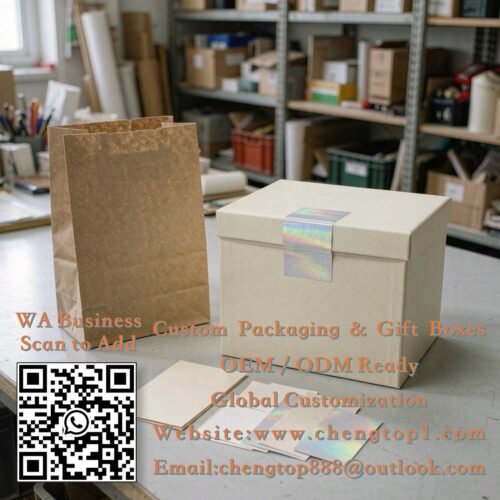
Counterfeiters exploit inconsistency more than absence. A brand whose boxes vary by supplier, whose bag colour drifts between reprints, and whose labels occasionally come from a local print shop gives fakers room to hide — buyers cannot recognise a “wrong” version of packaging that was never consistent in the first place. Consolidating packaging production so every unit carries the same board shade, the same foil tone and the same seal position does double duty: it sharpens brand recognition, and it turns small deviations into detection signals that staff, distributors and customers can act on. This is also the practical moment to add the seal — ordering paper bags and boxes and the authentication layer from one coordinated plan costs less than bolting security onto scattered suppliers later, and a seal applied across a closure in a fixed position doubles as a tamper check that compounds the authentication value.
When a Fake Appears: What Each Layer Contributes

The stack proves itself in the enforcement moment. A marketplace takedown is built from a registered trademark, evidence of infringement and proof of what genuine packaging looks like — the seal photograph from your packaging spec sheet becomes evidence, not decoration. Customs detention programmes in most export markets ask brand owners to submit authentication features in advance; a documented hologram with a described master pattern gives officers something checkable at the border. Distributor verification runs on the same feature: a partner who can tilt a seal and compare it against a reference avoids accepting a grey shipment in the first place. Where counterfeiting pressure is high, serialised codes layered under the seal turn each unit into a checkable record — but that escalation is worth the setup cost only after the cheaper layers are in place and monitoring shows a real pattern of infringement rather than isolated listings.
One last operational point: someone has to own the stack. In most small brands the plan drifts because registration sits with a lawyer, packaging with procurement and the seal with nobody in particular. Assign one owner who keeps the seal reference photos current, notes the seal generation on each packaging reorder, and updates the authentication spec whenever the packaging design changes — a seal from the previous generation left on old stock quietly teaches buyers that inconsistent packaging is normal, which is the exact opposite of what the stack is built to achieve.
Ready to Build the Stack?
Send us your packaging list and target markets — we will suggest a seal specification that fits the whole set, run a free artwork check and reply with a quote within 24 hours.